
By Vansh Dahiya · Reviewed by Arshi Chadha, Founder
How Apartment Residents Can Use Solar Without Rooftop Access
Quick answer
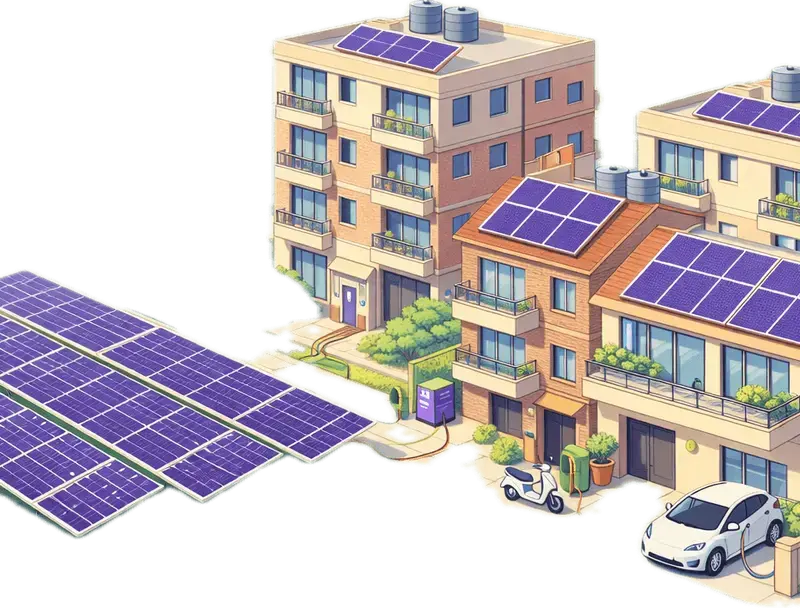
Apartment residents without private rooftops have three legal routes to solar in India. Group net metering (GNM) puts one plant on the society roof and credits multiple flat meters. Virtual net metering (VNM) credits your flat from a remote solar farm — Delhi has had this since 2019. Solar-as-service subscription delivers solar units to your meter for a fixed monthly fee with zero upfront cost. GNM and VNM require society NOC; subscription does not.
| Route | Upfront cost | Society NOC needed | Available in |
|---|---|---|---|
| Group net metering (GNM) | Rs.55–65k/kW installed | Yes | Delhi, MH, KA, TN |
| Virtual net metering (VNM) | Rs.55–65k/kW installed | No (remote plant) | Delhi, TN, KA |
| Solar subscription | Zero | No | Delhi NCR pilot |
- •Core Challenge: 85% of apartment dwellers in urban India lack individual rooftop access.
- •Top Solutions: Community solar, Virtual Net Metering (VNM), and Balcony DIY kits.
- •Savings Potential: 20% to 50% reduction in monthly electricity bills depending on the model.
- •Ease of Entry: Community solar requires ₹0 upfront cost, while private setups start at ₹40,000.
For years, the solar revolution in India was a privilege reserved for those who owned independent bungalows or villas. If you lived on the 10th floor of a high-rise in Mumbai, Bangalore, or Gurgaon, your desire to "go green" usually hit a concrete ceiling—the shared roof of your apartment complex. Most Residents' Welfare Associations (RWAs) prioritize common area lighting for rooftop installations, leaving individual flat owners with no way to offset their personal household consumption.
However, the landscape of Indian renewable energy is shifting. With the government’s push through PM Surya Ghar: Muft Bijli Yojana and evolving state policies on Virtual Net Metering, the dream of using solar without rooftop apartment India is finally a reality. You no longer need to own a roof to own the sun.
In this comprehensive guide, Bridgeway Power explores how urban residents can bypass traditional constraints and join the solar movement today.
The Barrier: Why Traditional Rooftop Solar Fails Apartments
In a standard residential setup, solar panels are wired directly to your home’s distribution board. For an apartment dweller, this presents three major hurdles:
- Shared Ownership: The roof is a "common area" belonging to the RWA.
- Structural Distance: Running cables from a 20th-floor roof to a 2nd-floor apartment is inefficient and expensive.
- Space Constraints: There isn't enough roof space for every resident to have their own dedicated plant.
This is where alternative models come in, allowing you to benefit from solar energy generated elsewhere.
1. Community Solar: The Easiest Way to Go Solar
Community solar is the most revolutionary way to access solar without rooftop apartment India. Think of it like a subscription service, similar to Netflix or a gym membership, but for clean energy.
How it Works
A developer (like Bridgeway Power) builds a large solar farm in a sunny, rural area where land is cheap. Apartment residents "subscribe" to a portion of the energy produced by that farm.
- No Installation: You don't need panels on your balcony or roof.
- Portability: If you move to another flat within the same DISCOM (utility) area, your subscription moves with you.
- Scalability: You can start by covering just 50% of your bill and increase it later.
To learn more about how these shared systems work, check out our guide on community solar.
2. Virtual Net Metering (VNM): The Policy Game Changer
Virtual Net Metering is a billing mechanism that allows credits from a solar project located at one site to be applied to the electricity accounts of multiple consumers elsewhere.
The VNM Process in India
In states like Delhi, Odisha, and increasingly in Karnataka, VNM policies allow an RWA to install a massive solar array on the roof or a nearby plot. The energy generated is fed into the grid. The utility company then "virtually" credits the electricity bills of individual flat owners based on their share of the investment.
Example: If the society solar plant generates 1,000 units and you own a 5% share, 50 units are deducted from your monthly bill, even though those panels aren't physically connected to your meter.
3. Society-Level Solar: Collective Benefits
Many Indian apartments are now opting for "RESCO" models (Renewable Energy Service Company). Here, the society provides the roof, a provider installs the system at zero cost, and the residents buy the power at a rate 30-40% lower than the grid price.
While this often powers common areas (lifts, water pumps, corridor lights), it significantly reduces the "Maintenance Charges" flat owners have to pay, providing an indirect but substantial saving.
4. Balcony Solar Panels: The Rising Urban Trend
For those who want a physical setup but lack a roof, Plug-and-Play Balcony Solar is gaining traction. These are small-scale systems (typically 300W to 1kW) designed to hang on balcony railings.
- Pros: Total control, portable, no RWA permission usually required for small kits.
- Cons: Lower efficiency due to shading from upper floors and limited sun hours.
Comparing Your Options: Which is Best for You?
If you are looking for solar without rooftop apartment India, use this table to decide which route fits your lifestyle and budget.
Table 1: Comparison of Solar Solutions for Apartment Residents (2025-26)
| Feature | Community Solar | Virtual Net Metering (VNM) | Balcony Solar Panels |
|---|---|---|---|
| Upfront Cost | Low (Subscription based) | Moderate to High | Moderate (₹40k - ₹1.2L) |
| Rooftop Needed? | No | Yes (Offsite or Society roof) | No (Uses Balcony) |
| Maintenance | Handled by Provider | Handled by Society/Vendor | DIY / User Responsibility |
| Best For | Tenants & High-rise Owners | Cooperative Housing Societies | DIY enthusiasts / Small loads |
| Scalability | High | Medium | Low |
| Grid Interaction | Credits applied to bill | Direct Net Metering credit | Off-grid or Micro-inverter |
Talk to a solar engineer — not a salesperson
Enter your pincode and monthly bill. If we install in your area, an engineer answers on WhatsApp with your numbers.
What would solar save on YOUR bill?
Understanding the Savings Potential
The primary motivation for switching to solar is financial. Even without a roof, the savings can be significant.
Table 2: Estimated Monthly Savings Potential (For a typical 3BHK consuming 400 units/month)
| Option | Investment Type | Est. Monthly Saving | Payback Period |
|---|---|---|---|
| Community Solar | ₹0 Upfront (Monthly Fee) | ₹800 - ₹1,200 | Immediate |
| VNM (Shared Plant) | ₹1.5 Lakh (One-time) | ₹2,500 - ₹3,200 | 4 - 5 Years |
| Balcony Solar (1kW) | ₹65,000 (One-time) | ₹600 - ₹900 | 6 - 7 Years |
| Society RESCO | N/A (Reduced Maintenance) | ₹500 - ₹1,000 | Immediate |
Note: Figures are based on an average tariff of ₹8/unit and typical solar generation of 4 units per kW per day in Indian conditions.
Real Life Example: The "Green Tower" Success Story
In late 2024, a premium apartment complex in Sarjapur, Bangalore, faced rising electricity costs for common areas and high individual bills.
The Challenge: 120 flats, but only enough roof space for a 60kW system—not enough to power every home.
The Solution:
- The RWA utilized the roof for a 50kW system to cover common area utilities (Lifts, STP, Lighting).
- Bridgeway Power facilitated a Community Solar partnership for the individual flat owners.
- Interested residents subscribed to a 3kW share in an off-site solar park located 80km away.
The Result:
- The RWA reduced maintenance charges by ₹450 per flat.
- Residents who subscribed to the community solar saw their personal electricity bills drop from ₹4,500 to roughly ₹1,800.
- All this was achieved without a single panel being installed on a private balcony.
How to Get Started: Step-by-Step
If you want to access solar without rooftop apartment India, follow these steps:
- Audit Your Consumption: Check your last 6 months of electricity bills to find your average monthly unit consumption.
- Check Local Regulations: Contact your DISCOM (e.g., BESCOM, Tata Power, MSEDCL) to see if Virtual Net Metering is supported in your area.
- Talk to Your RWA: If the whole building moves toward a VNM or RESCO model, the benefits are 2x higher for everyone.
- Explore Subscriptions: If your RWA is hesitant, look for third-party community solar providers who offer individual subscription plans.
- Consult an Expert: Companies like Bridgeway Power can provide a feasibility report for your specific location and apartment type.
Frequently Asked Questions
Can I get a government subsidy for community solar?
Currently, the PM Surya Ghar subsidy is primarily focused on behind-the-meter rooftop installations. However, many states are drafting policies to extend financial incentives to VNM projects and group housing societies. It is best to check the latest MNRE circulars for your specific state.
What happens if I move to a different city?
If you move within the same state and keep the same electricity provider, your community solar credits can often be transferred. If you move out of state, you can typically "sell" or transfer your subscription share to another resident or back to the provider.
Is balcony solar legal in India?
Yes, but you must ensure the equipment is certified (BIS standards). Furthermore, if you are using a grid-tied micro-inverter, you technically need DISCOM approval. Most residents use off-grid kits with small batteries to avoid legal complications with net metering.
How much space do I need on my balcony for solar?
A standard 330W panel is roughly 6.5ft x 3.2ft. To make a meaningful impact (e.g., 1kW), you would need space for three such panels. This is only feasible for apartments with long, south-facing balconies.
Does community solar work on cloudy days?
Yes. Solar panels still generate electricity in diffused light, though at a lower rate (20-30% of peak). Because community solar farms are often located in high-irradiance zones, their overall annual production is usually more stable than a small home setup.
Conclusion: The Future is Shared
Living in an apartment should no longer stop you from contributing to a greener planet and saving money. Whether it is through a shared society plant, a sophisticated virtual net metering setup, or a simple community solar subscription, the barriers are falling.
At Bridgeway Power, we specialize in navigating the complexities of urban solar. With 35+ years of experience in the Indian power sector, we help residents and RWAs transition to clean energy with zero stress.
Ready to slash your apartment's electricity bill? Contact Bridgeway Power today for a free consultation on how you can use solar without rooftop apartment India solutions. High-rise living has never been this bright!
Every 1 kW of solar on your roof offsets 1.5 tonnes of CO₂ per year
That's 40 trees planted — every year, for 25 years.
A typical 5 kW home system offsets 187 tonnes of carbon over its lifetime. That's equivalent to taking 8 cars off the road.
See your impact →How much can you save with solar?
Enter your electricity bill → get system size, subsidy amount & payback period
Get StartedGo solar without owning a rooftop
Community Solar gives commercial & institutional consumers the same savings — zero capex, zero roof needed.
Or get a free solar quote
Tell us about your rooftop — we'll call with exact savings for your home.
Related Articles
Lock In a Fixed Electricity Rate for Your School — Before Delhi Tariffs Rise Again
Lock in your school's electricity rate before Delhi tariffs hit ₹16/unit. Learn how Community Solar offers zero-capex savings of ₹10L+ annually.
Read moreWhat Delhi's Solar Policy Means for Apartment Owners and Non-Rooftop Residents
Discover how Delhi's 2026 solar policy enables apartment owners to save 40% on bills using Virtual Net Metering. No roof access or RWA NOC required.
Read moreVirtual Net Metering (VNM) in India: How It Enables Community Solar for Homeowners
Learn how Virtual Net Metering (VNM) enables community solar in India. Discover how DERC and RERC policies allow flat owners to share solar credits without individual rooftops.
Read moreRelated guides
Delhi Electricity Rate 2026
BSES & Tata Power per-unit rates, PPAC, subsidy — sourced from DERC.
ExploreDelhi Solar Policy 2026
Free rooftop solar up to 3 kW for homes under 400 units. Eligibility & apply.
ExploreSolar Panel Price in Delhi
Live 2026 rooftop prices in Delhi after ₹1.56L subsidy. 1,200+ installs.
ExploreSolar Company in Gurgaon
Gurgaon's rooftop solar installer — 800+ systems, ₹78K PM Surya Ghar subsidy.
ExploreSolar Company in Noida
Noida & Greater Noida rooftop solar — 500+ installs, ₹1.08L stacked subsidy.
ExploreSolar Panel Price in Faridabad
Live 2026 Faridabad prices after ₹78K PM Surya Ghar subsidy. 350+ homes.
Explore