
By Kajal Rajpoot · Reviewed by Arshi Chadha, Founder
No Rooftop? No Problem. How Delhi Businesses Get Solar Without a Single Panel.
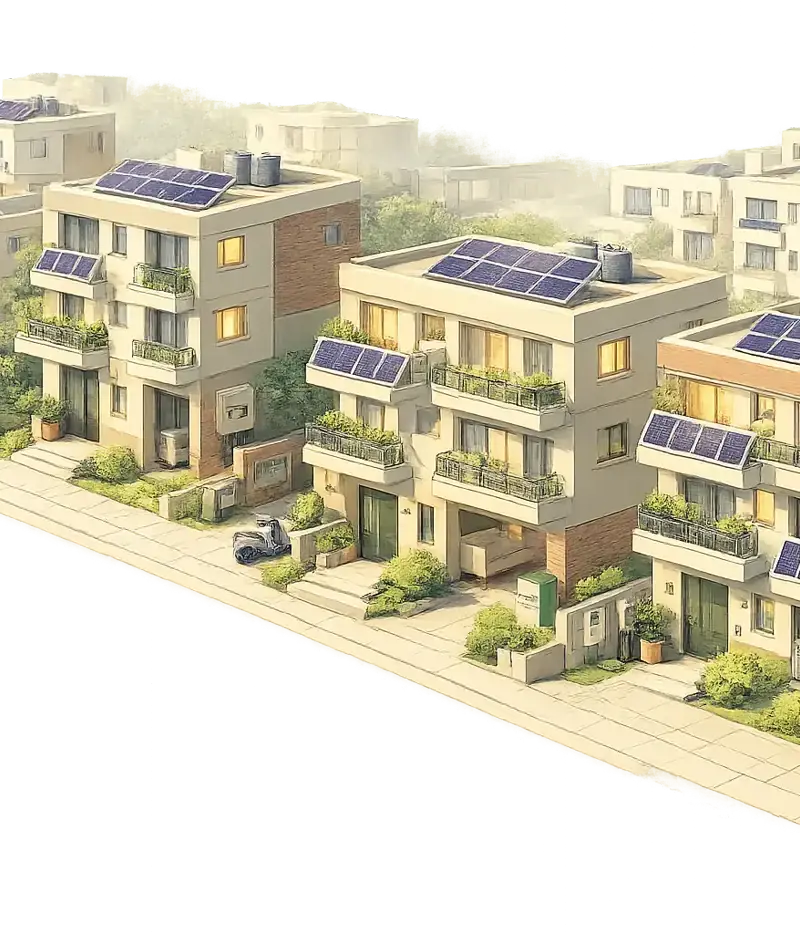
- •System Model: Offsite Community Solar / Virtual Net Metering
- •Investment: Zero Capex (Subscription-based) or Fractional Ownership
- •Monthly Savings: 25% – 45% on Grid Tariffs
- •Execution Time: 15–30 Days (Paperwork only)
- •Eligibility: Any BSES or Tata Power commercial connection in Delhi
For decades, the image of "going solar" has been synonymous with heavy cranes, months of construction, and rows of blue panels on a roof. But in a dense urban landscape like Delhi, that image is often a pipe dream. If you run a high-end boutique in South Extension, a dental clinic in Greater Kailash, or a corporate office in Sushant Lok, you likely face the "No Roof" dilemma.
Perhaps you rent your office. Perhaps your building is a heritage structure with strict aesthetic rules. Or perhaps your roof is already crowded with massive VRV air-conditioning units and water tanks. Does this mean you are doomed to pay the highest commercial electricity tariffs in the country forever?
The answer is a resounding "No." Thanks to evolving regulations by the Delhi Electricity Regulatory Commission, a new era of C&I solar without roof Delhi has arrived. It is called Community Solar, powered by Virtual Net Metering (VNM). At Bridgeway Power, with our 35-year legacy, we are helping businesses transition to clean energy without driving a single screw into their ceilings.
Why 60% of Delhi Businesses Can’t Install Rooftop Solar
If you’ve explored solar before and were told "it’s not possible," you aren't alone. In fact, our internal data suggests that more than 60% of commercial buildings in Delhi NCR are structurally or legally ineligible for traditional rooftop installations.
Common Barriers to Rooftop Solar for C&I Consumers
| Constraint Type | Percentage of Delhi Businesses Affected | Description |
|---|---|---|
| Leased/Rented Premises | 40% | Tenants cannot modify the landlord's property or lack long-term roof rights. |
| Structural Constraints | 20% | Roofs cannot handle the load of panels and structures, or have no space due to HVAC. |
| Shared Roofs / Societies | 25% | Multiple owners in one building cannot agree on roof space allocation. |
| Heritage / Restricted | 15% | Lutyens' Delhi or restricted zones where rooftop modifications are prohibited. |
This is where offsite solar commercial Delhi models step in. You no longer need to own the "ground" or the "roof" to own the "power."
The Magic of Virtual Net Metering (VNM)
The backbone of community solar no roof India is a regulatory mechanism called Virtual Net Metering. Unlike traditional net metering where the solar system is physically wired to your meter, VNM allows the solar energy to be generated at a distant, sunny location and "virtually" credited to your electricity bill.
How Virtual Net Metering Works for Your Business
| Step | Process | What Happens? |
|---|---|---|
| 1. Generation | The Solar Farm | A large-scale solar plant is built in a high-yield area outside the city. |
| 2. Injection | Grid Feeding | The power is fed directly into the state grid (DISCOM network). |
| 3. Calculation | Credit Assignment | Your share of the generation is measured by a dedicated meter at the farm. |
| 4. Offsetting | Bill Credit | The DISCOM (BSES/Tata Power) deducts these units from your office bill. |
| 5. Final Bill | Net Payment | You only pay for the "Net" units used after the solar credit. |
This makes virtual net metering business Delhi the most scalable way for city-based enterprises to go green. You can learn more about the technical details in our guide on Virtual Net Metering in India.
No Panels, No Maintenance: Why Offsite Solar Wins
When you opt for C&I solar without roof Delhi, you aren't just saving on space; you are saving on headaches.
1. Zero Infrastructure Risks
Traditional rooftop solar involves adding weight to your building. While a solar system weighs less than a water tank, many old buildings in areas like Chandni Chowk or Paharganj still face structural anxiety. Offsite solar removes this risk entirely.
2. Expert Operations & Maintenance (O&M)
Rooftop panels in dusty cities like Delhi can lose up to 25% efficiency if not cleaned weekly. In a community solar model, the solar farm is professionally maintained by the developer. You don't have to worry about bird droppings or soiling losses.
3. Portable Power
Perhaps the biggest advantage for Delhi’s retail and office sector: Portability. If you move your office from Noida Extension to Gurgaon, your solar credits can often move with you, provided you stay within the same DISCOM’s jurisdiction. Try doing that with 50 panels bolted to a roof!
Real Savings: The Math of Offsite Solar
Commercial electricity rates in Delhi can touch ₹10–14 per unit when including various surcharges like the PPAC Surcharge. By subscribing to a community solar project, you effectively "lock in" a much lower rate for a portion of your electricity.
Savings Comparison: Grid vs. Community Solar
| Metric | Traditional Grid Bill | With Community Solar (VNM) |
|---|---|---|
| Monthly Consumption | 500 Units | 500 Units |
| Average Tariff | ₹14.00 / unit | ₹14.00 / unit |
| Solar Generation Credit | 0 Units | 400 Units |
| Solar Subscription Cost | ₹0 | ₹2,200 (approx. ₹5.5/unit) |
| Remaining Grid Units to Pay | 500 Units | 100 Units |
| Grid Bill Amount | ₹7,000 | ₹1,400 |
| Total Monthly Cost | ₹7,000 | ₹3,600 (Total Savings: ~48%) |
Note: Actual savings depend on the specific project tariff and your current DISCOM slab. For a precise calculation, use our Solar Calculator.
Talk to a solar engineer — not a salesperson
Enter your pincode and monthly bill. If we install in your area, an engineer answers on WhatsApp with your numbers.
What would solar save on YOUR bill?
Solar Depreciation & Tax Benefit Calculator
Based on Section 32 — 40% WDV + 20% additional depreciation (Year 1)
Who Is This For?
The "No Roof" solar model is a horizontal solution that fits almost every commercial category in Delhi:
- Retail Outlets: High-energy users (lighting/AC) in malls or high streets where they don't own the roof.
- Clinics & Diagnostic Centres: Reliable savings without the vibration or noise of onsite construction.
- Warehouses: Even if you have a roof, fire insurance or structural specs might prevent panel installation.
- Schools & Hospitals: Large institutions can centralize their solar strategy across multiple campuses using one offsite plant.
- Multi-Location Businesses: A bank with 20 branches across Delhi can subscribe to one large offsite solar capacity rather than managing 20 tiny rooftop plants.
Real Example: A South Delhi Marketing Agency
Imagine a 20-person marketing agency based in a rented basement and first floor in Defence Colony.
- The Problem: Their monthly bill is ₹18,000. They want to go solar, but the landlord refuses to let them use the roof for "aesthetic reasons."
- The Solution: They subscribe to a 5kW share of a Bridgeway-managed community solar farm.
- The Result: They pay no upfront cost for panels. Their DISCOM bill now shows a "Solar Credit" of ~600 units every month. Their net bill drops from ₹18,000 to approximately ₹11,000.
- The Best Part: When their lease ends next year and they move to a larger office in Janakpuri, they simply update their CA (Connection Account) number with us to continue receiving credits at the new location.
How to Get Started with Bridgeway Power
Going solar without a roof is a purely administrative and financial transition—not a construction one.
- Bill Analysis: Share your last 6 months of electricity bills. We analyze your consumption pattern to determine the ideal solar "subscription" size.
- Subscription/Ownership: Choose between a monthly subscription (Zero Capex) or a fractional ownership model.
- Registration: We handle the paperwork with BSES Rajdhani or Tata Power DDL to register your account for Virtual Net Metering.
- Activation: Within 30 days, your solar credits begin appearing on your monthly DISCOM bill.
The Future of Solar in Delhi
As part of India's mission to see 1 crore homes go solar under the PM Surya Ghar Yojana, the C&I sector is also being pushed toward cleaner alternatives. With residential consumers getting high subsidies, commercial tariffs are expected to rise to compensate. Locking in your rates through offsite solar commercial Delhi is the only way to shield your business from these future shocks.
At Bridgeway Power, our 25+ MW of installed capacity and 35+ years of experience mean we don't just sell you a product; we manage your energy future. Whether it is Open Access Solar for large factories or community solar no roof India for small shops, we have the expertise to make it work.
Frequently Asked Questions
Does community solar work if I am a tenant?
Yes! Virtual net metering is designed specifically for tenants. Since there is no physical installation on the rented property, you do not need the same level of structural permissions as rooftop solar, though a basic NOC from the landlord may be required depending on the DISCOM.
Will I still get an electricity bill from BSES/Tata Power?
Yes. You will remain a customer of your DISCOM. The only difference is that your bill will feature a "Solar Export Credit" line item, which reduces the final amount you owe.
What happens if the solar farm produces less power during monsoon?
Solar generation is averaged over the year. While units may be lower in July, they are significantly higher in March–May. Your credits are based on actual generation, and our plants are maintained using Tier-1 components to ensure 99% uptime.
Can I get a subsidy for offsite commercial solar?
No. Central government subsidies like PM Surya Ghar are strictly for residential rooftops. However, businesses benefit from accelerated depreciation (40%) if they opt for the ownership model and significant GST benefits.
Is there a minimum bill requirement?
For the most effective ROI, we recommend community solar for businesses with a monthly bill of at least ₹5,000–8,000. For very small shops, the administrative costs of VNM might outweigh the initial savings.
Conclusion
The lack of a rooftop is no longer a valid excuse for ignoring solar energy. In 2026, the technology and the law have caught up to the needs of the urban business owner. C&I solar without roof Delhi is a clean, hassle-free, and highly profitable way to slash your overheads and contribute to a greener Delhi.
Ready to see how much your "Virtual" solar plant can save you? Contact Bridgeway Power for a Free Consultation or use our Solar Calculator to estimate your savings today. We’ve powered 5,000+ rooftops—now let us power your business, even without one. Areas like Saket, Dwarka, and Noida are already leading the shift. Don't be left behind in the dark.
Every 1 kW of solar on your roof offsets 1.5 tonnes of CO₂ per year
That's 40 trees planted — every year, for 25 years.
A typical 5 kW home system offsets 187 tonnes of carbon over its lifetime. That's equivalent to taking 8 cars off the road.
See your impact →How much can you save with solar?
Enter your electricity bill → get system size, subsidy amount & payback period
Get StartedGo solar without owning a rooftop
Community Solar gives commercial & institutional consumers the same savings — zero capex, zero roof needed.
Or get a free solar quote
Tell us about your rooftop — we'll call with exact savings for your home.
Related Articles
Lock In a Fixed Electricity Rate for Your School — Before Delhi Tariffs Rise Again
Lock in your school's electricity rate before Delhi tariffs hit ₹16/unit. Learn how Community Solar offers zero-capex savings of ₹10L+ annually.
Read moreWhat Delhi's Solar Policy Means for Apartment Owners and Non-Rooftop Residents
Discover how Delhi's 2026 solar policy enables apartment owners to save 40% on bills using Virtual Net Metering. No roof access or RWA NOC required.
Read moreVirtual Net Metering (VNM) in India: How It Enables Community Solar for Homeowners
Learn how Virtual Net Metering (VNM) enables community solar in India. Discover how DERC and RERC policies allow flat owners to share solar credits without individual rooftops.
Read moreRelated guides
Delhi Electricity Rate 2026
BSES & Tata Power per-unit rates, PPAC, subsidy — sourced from DERC.
ExploreDelhi Solar Policy 2026
Free rooftop solar up to 3 kW for homes under 400 units. Eligibility & apply.
ExploreSolar Panel Price in Delhi
Live 2026 rooftop prices in Delhi after ₹1.56L subsidy. 1,200+ installs.
ExploreSolar Company in Gurgaon
Gurgaon's rooftop solar installer — 800+ systems, ₹78K PM Surya Ghar subsidy.
ExploreSolar Company in Noida
Noida & Greater Noida rooftop solar — 500+ installs, ₹1.08L stacked subsidy.
ExploreSolar Panel Price in Faridabad
Live 2026 Faridabad prices after ₹78K PM Surya Ghar subsidy. 350+ homes.
Explore