
By Bhawna Thakur · Reviewed by Arshi Chadha, Founder
Future of Rooftop Solar in India: 1 Crore Homes Going Solar
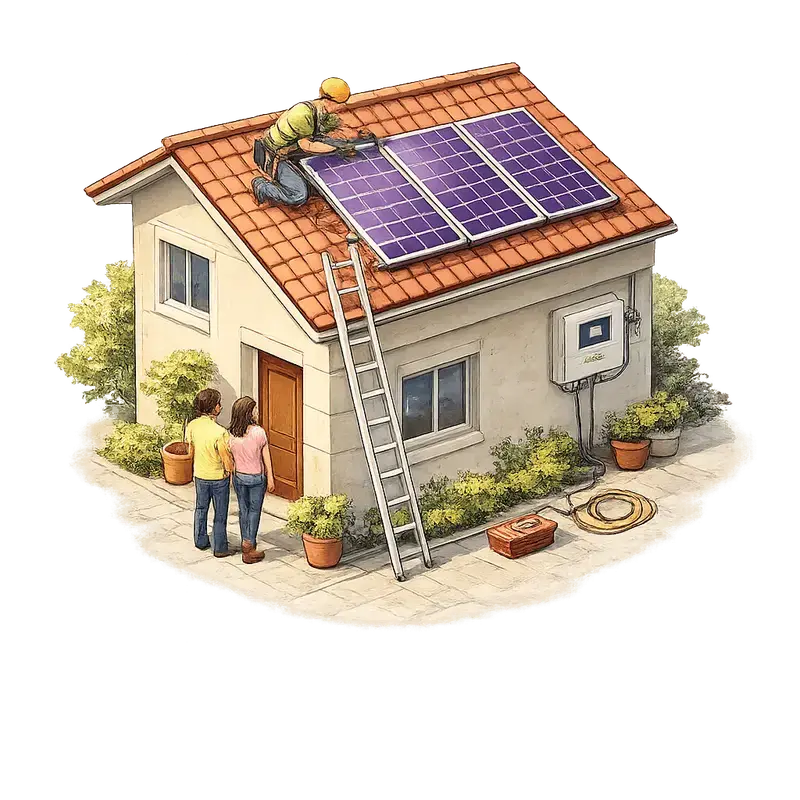
- •Government Target: 1 Crore (10 Million) households to be solarized.
- •Financial Outlay: ₹75,021 Crore dedicated to the PM Surya Ghar scheme.
- •Average Subsidy: Up to ₹78,000 for a 3kW system.
- •Primary Drivers: Reduced equipment costs, favorable net-metering, and EV integration.
- •Environmental Impact: Potential reduction of 33 million tonnes of CO2 emissions annually.
The Indian skyline is undergoing a quiet, golden revolution. For decades, the rooftop solar India future was a niche conversation restricted to eco-conscious enthusiasts or high-end industrial units. However, with the launch of the ambitious PM Surya Ghar: Muft Bijli Yojana, the narrative has shifted from 'if' to 'when.'
Imagine an India where every middle-class household becomes a mini-power plant. Your rooftop doesn't just protect you from the rain; it wipes out your monthly electricity bill and charges your electric scooter for free. This isn't a futuristic dream—it is the direct objective of the Government of India as it targets 1 crore homes for solar transition. At Bridgeway Power, with over 35 years of energy expertise, we are seeing a 300% surge in inquiries as homeowners realize that solar is no longer an expense—it is the highest-yielding financial investment available in 2025.
The Pillars of the PM Surya Ghar: Muft Bijli Yojana
The heartbeat of the rooftop solar India future is the Muft Bijli Yojana. Unlike previous iterations of solar subsidies which were often mired in bureaucracy, this 2024-2026 push is designed for speed and scale.
Table 1: PM Surya Ghar Muft Bijli Yojana Overview
| Feature | Details |
|---|---|
| National Target | 1 Crore (10 Million) Households |
| Total Financial Outlay | ₹75,021 Crore |
| Maximum Subsidy (Up to 2kW) | ₹30,000 per kW |
| Maximum Subsidy (Above 3kW) | ₹78,000 flat |
| Annual Free Electricity | Approx. 300 units per month |
The government has simplified the process through a national portal, enabling homeowners to apply, choose a vendor, and track their subsidy directly into their bank accounts. This transparency is the catalyst for the massive adoption we are witnessing today.
Why 2025 is the Turning Point for Rooftop Solar
The rooftop solar India future is being shaped by a "perfect storm" of falling prices and rising efficiency.
1. Solar Prices Dropping 10-15% Year-over-Year
The cost of Lithium-ion batteries and Mono-PERC solar cells has plummeted globally. In the Indian market, we have observed a year-on-year price reduction of nearly 15%. This means the "payback period"—the time it takes for the system to pay for itself through bill savings—has dropped from 5-6 years to just 3-4 years in most states.
2. Government Target of 40 GW by 2026
While the initial utility-scale solar projects (large solar parks) were the focus, the Ministry of New and Renewable Energy (MNRE) has pivoted toward the retail consumer. The goal is to achieve 40 GW of cumulative rooftop solar capacity by 2026. To reach this, the government is incentivizing DISCOMs (Distribution Companies) to make net-metering approvals faster and more consumer-friendly.
Table 2: Year-wise Installation Targets and Estimated Progress
| Financial Year | Target (Cumulative GW) | Status/Outlook |
|---|---|---|
| 2021-22 | 6.6 GW | Achieved |
| 2022-23 | 8.8 GW | Achieved |
| 2023-24 | 12.0 GW | Rapid Expansion |
| 2024-25 (Projected) | 22.0 GW | PM Surya Ghar Launch |
| 2025-26 (Projected) | 40.0 GW | 1 Crore Homes Threshold |
State-wise Adoption: Who is Leading the Race?
The rooftop solar India future isn't uniform across the country. States with high solar radiation and progressive net-metering policies are leading the charge. Gujarat, specifically, has become the "Solar Factory of India," accounting for nearly 25% of all residential rooftop installations.
Table 3: State-wise Rooftop Solar Adoption Rates (Current Leaderboard)
| State | Leadership Status | Key Driver |
|---|---|---|
| Gujarat | Market Leader | SURYA Gujarat Scheme & Industrial base |
| Maharashtra | High Growth | High industrial tariffs driving residential shift |
| Rajasthan | Highest Potential | Maximum sunlight hours (300+ days) |
| Kerala | Policy Innovator | KSEB's "Soura" program and high literacy |
| Delhi/NCR | Urban Hub | Generous subsidies and high energy demand |
Emerging Trends: More Than Just Panels
As we look at the rooftop solar India future, the technology is evolving beyond simple photovoltaic panels.
Battery Storage Integration
"Going off-grid" is becoming a reality. With the falling cost of Energy Storage Systems (ESS), homeowners are now opting for hybrid systems. These systems store solar energy produced during the day to power the house at night, providing 24/7 energy independence even during grid failures.
Talk to a solar engineer — not a salesperson
Check whether we install in your area, then get your answer on WhatsApp. No forms, no call centre.
What would solar save on YOUR bill?
EV Charging Synergy
With the rise of Tata Nexons, MGs, and Ather scooters, residential solar is becoming the "fuel station" of the home. Using our solar calculator, many users find that by adding an extra 1kW to their rooftop system, they can drive their EVs 50km daily for absolutely ₹0.
Community Solar and Virtual Net Metering
For those living in high-rise apartments with limited roof space, the concept of community solar is gaining traction. This allows multiple residents to share a single large-scale solar plant located elsewhere, receiving credits on their individual electricity bills.
Real-World Example: The Math of a Solar Home
Let's look at a practical scenario for a homeowner in 2025.
The Client: Mr. Sharma, a resident of Bangalore with a 3BHK house. Monthly Bill: ₹6,500 (approx. 550 units). Installed System: 5kW On-grid Solar System.
- Total Project Cost: ₹3,20,000
- Govt. Subsidy Received: ₹78,000
- Net Investment: ₹2,42,000
- Monthly Generation: ~600 Units
- Monthly Savings: ~₹5,000 - ₹6,000
- Annual Savings: ₹60,000 - ₹72,000
- Payback Period: ~3.5 Years
- System Lifespan: 25 Years (Post-payback profit period: 21 years!)
In this scenario, Mr. Sharma is essentially pre-paying 25 years of electricity at the price of 3.5 years of current bills.
The Role of Bridgeway Power
With 35 years of heritage, Bridgeway Power is uniquely positioned to lead the rooftop solar India future. We don't just "install panels"; we engineer energy solutions. From structural integrity checks to navigating the complex subsidy paperwork of PM Surya Ghar, we ensure that your transition to solar is seamless.
Frequently Asked Questions
What happens if my solar panels produce more electricity than I use?
Under the net-metering policy, any excess electricity generated by your system is automatically fed back into the government grid. Your electricity board tracks this and gives you credits on your next bill. At the end of the financial year, many states even pay you for the surplus energy generated.
Is my roof strong enough for solar panels?
Typical solar panels weigh about 12-15 kg per square meter. Most RCC (concrete) roofs in India are designed to handle much higher loads. However, at Bridgeway Power, we perform a mandatory structural assessment before every installation to ensure your roof’s safety for the next 25 years.
How do I apply for the PM Surya Ghar subsidy in 2025?
Homeowners must register on the National Portal for Rooftop Solar. You will need your electricity consumer number, a photo of your roof, and a cancelled cheque. Once registered, you choose an empanelled vendor like Bridgeway Power to carry out the installation. The subsidy is released directly to your account after the DISCOM completes the inspection.
Do solar panels work during the monsoon or on cloudy days?
Yes, they do! Solar panels work on light, not just heat. While production may drop to 20-30% on very dark, rainy days, the cumulative generation over the year remains high. India’s tropical climate makes it one of the best locations globally for consistent solar production.
What is the maintenance cost for a rooftop solar system?
Maintenance is remarkably low since there are no moving parts. The primary requirement is cleaning the dust off the panels every 2-3 weeks with plain water. Most systems require an inverter check-up once every few years, but the panels themselves often come with a 25-year performance warranty.
Conclusion: Join the 1 Crore Movement
The rooftop solar India future is no longer a distant vision; it is a live, government-backed initiative that is economically superior to staying on the grid. By solarizing 1 crore homes, India is not just reducing its carbon footprint—it is putting money back into the pockets of the common citizen.
Are you ready to be part of the 1 crore? [Book a free site survey with Bridgeway Power today] and let our experts design a high-efficiency solar solution tailored for your home. Stop paying for power when you can own it.
Every 1 kW of solar on your roof offsets 1.5 tonnes of CO₂ per year
That's 40 trees planted — every year, for 25 years.
A typical 5 kW home system offsets 187 tonnes of carbon over its lifetime. That's equivalent to taking 8 cars off the road.
See your impact →Get your exact solar cost — free in 30 seconds
Enter your electricity bill → see system size, govt subsidy & payback period
Get StartedLiked this article? Get a free solar quote
Tell us about your rooftop — we'll call with exact savings for your home.
Related Articles
Net Metering in India: How to Sell Solar Power Back to the Grid
Learn how net metering in India allows you to sell solar power back to the grid. Discover state policies, savings examples, and how to reduce your bill by 90%.
Read moreWhat Is Captive Open Access Solar (100% Equity Model)
Learn how Captive Open Access Solar (100% Equity Model) helps Indian businesses cut electricity costs by 40% using off-site solar plants. Guide on rules, savings & ROI.
Read moreSolar Installation Cost in Delhi NCR 2026: 3 kW at ₹1.32L net
Updated 2026 guide to solar costs in Delhi NCR. Learn about PM Surya Ghar subsidies, system pricing from 1kW-10kW, and how to reach zero electricity bills.
Read moreRelated guides
Delhi Electricity Rate 2026
BSES & Tata Power per-unit rates, PPAC, subsidy — sourced from DERC.
ExploreDelhi Solar Policy 2026
Free rooftop solar up to 3 kW for homes under 400 units. Eligibility & apply.
ExploreSolar Panel Price in Delhi
Live 2026 rooftop prices in Delhi after ₹1.56L subsidy. 1,200+ installs.
ExploreSolar Company in Gurgaon
Gurgaon's rooftop solar installer — 800+ systems, ₹78K PM Surya Ghar subsidy.
ExploreSolar Company in Noida
Noida & Greater Noida rooftop solar — 500+ installs, ₹1.08L stacked subsidy.
ExploreSolar Panel Price in Faridabad
Live 2026 Faridabad prices after ₹78K PM Surya Ghar subsidy. 350+ homes.
Explore