
By Mahendra Singh · Reviewed by Arshi Chadha, Founder
ISTS Waiver for Solar in 2026: What is Still Applicable
- •ISTS Waiver Status: Fully applicable for solar projects commissioned by 30th June 2025; tiered reduction thereafter.
- •Financial Impact: Reduces landed power costs by ₹0.50–₹0.80 per unit for Inter-State projects.
- •Key Beneficiaries: Large Commercial & Industrial (C&I) consumers using Open Access.
- •2026 Outlook: A 25% waiver remains applicable for projects commissioned before June 2026.
Navigating the landscape of Inter-State Transmission System (ISTS) charges can feel like deciphering a complex legal code. For large-scale industrial power consumers in India, these charges often represent the difference between a viable solar project and a financial deadlock.
As we move into 2026, the "Golden Era" of 100% ISTS waivers is transitioning into a tiered phase-out. With India’s aggressive goal of 500 GW of non-fossil fuel capacity by 2030, the Ministry of Power has recalibrated these incentives to balance grid infrastructure costs with renewable energy growth. If you are a business owner in Delhi or a factory manager in Faridabad looking at sourcing solar power from Rajasthan or Gujarat, understanding the ISTS waiver solar 2026 landscape is critical for your Long-term Power Purchase Agreement (PPA) strategy.
What is the ISTS Waiver?
The Inter-State Transmission System (ISTS) is the network of high-voltage transmission lines that move electricity across state borders. Usually, users pay "wheeling" or transmission charges to the Power Grid Corporation of India (PGCIL) to move this power.
To promote renewable energy, the Government of India introduced a waiver on these charges for solar and wind power. This meant that a factory in Haryana could buy solar power from a park in Rajasthan without paying the heavy inter-state transit fees, making solar significantly cheaper than grid power from local DISCOMs like DHBVN or UHBVN.
ISTS Waiver Deadline: The 2026 Tiers
The most important thing to know about the ISTS waiver solar 2026 status is the "Commissioning Date." The waiver is not disappearing overnight; it is being reduced in annual steps.
Transmission Charge Waiver Schedule (Solar & Wind)
| Commissioning Date (Up to) | Waiver Percentage | Applicable Duration |
|---|---|---|
| Up to 30th June 2025 | 100% | 25 Years |
| 1st July 2025 – 30th June 2026 | 75% | 25 Years |
| 1st July 2026 – 30th June 2027 | 50% | 25 Years |
| 1st July 2027 – 30th June 2028 | 25% | 25 Years |
| Post 30th June 2028 | 0% | N/A |
Note: The waiver remains applicable for a period of 25 years from the date of commissioning, provided the project hits the specific window.
Why the ISTS Waiver Solar 2026 Status Matters for C&I
In 2026, businesses will likely fall into the 75% or 50% waiver category. While not as lucrative as the 100% waiver, this still provides a massive competitive advantage over traditional thermal power.
For a typical C&I consumer in North India, transmission charges can range from ₹0.60 to ₹1.20 per unit. Even a 75% waiver saves approximately ₹0.45 to ₹0.90 per unit. When multiplied by millions of units consumed annually, this equals crores in savings.
Comparison: ISTS vs. Local Grid Tariffs (2025-26)
| Component | Local DISCOM (Commercial) | ISTS Solar (75% Waiver - 2026) |
|---|---|---|
| Energy Charge | ₹8.00 – ₹10.00 | ₹3.50 – ₹4.00 |
| Transmission/Wheeling | Included | ₹0.20 (Remaining 25%) |
| Cross Subsidy Surcharge | N/A | ₹1.50 – ₹2.50 |
| Landed Cost | ₹9.00+ | ₹5.20 – ₹6.70 |
Businesses looking to maximize these savings should also explore how to reduce commercial electricity bills in Delhi NCR.
Green Energy Open Access (GEOA) Rules 2026
The ISTS waiver works in tandem with the Green Energy Open Access Rules. In 2026, the eligibility limit for Open Access remains at 100 kW. This means even smaller MSMEs can now tap into inter-state solar power, which was previously reserved for massive industries with 1 MW+ loads.
Key Provisions for 2026:
- Uniform Application Process: A single national portal for all Open Access approvals.
- No Limit on Supply: Consumers can source up to 100% of their demand from renewable sources.
- Banking Provisions: Monthly banking is generally permitted, though charges vary by state.
For MSMEs specifically, the SIDBI 4E Solar Loan offers an excellent way to finance the equity portion of such projects.
Real-World Example: A Textile Mill in Ghaziabad
Let’s look at a practical scenario for 2026. A textile mill in Ghaziabad has a sanctioned load of 2 MW. Their average grid tariff is ₹8.50/unit.
- Scenario A: Stay on the grid. Monthly bill for 3 lakh units: ₹25.5 Lakh.
- Scenario B: Solar Open Access (ISTS) commissioned in Oct 2025 (75% waiver).
- Solar PPA Rate: ₹4.20
- ISTS Charge (25% of ₹0.80): ₹0.20
- Other OA Charges (CSS, AS): ₹1.80
- Total Landed Cost: ₹6.20
- Monthly bill for 3 lakh units: ₹18.6 Lakh.
Monthly Savings: ₹6.9 Lakh | Annual Savings: ₹82.8 Lakh.
Even without a 100% waiver, the mill saves over 25% on its energy costs. Businesses can use our Solar Calculator to estimate similar returns for rooftop installations.
Specific Exemptions Still Applicable in 2026
While the general waiver is tapering, the government has provided "bonus" windows for specific technologies:
Talk to a solar engineer — not a salesperson
Enter your pincode and monthly bill. If we install in your area, an engineer answers on WhatsApp with your numbers.
What would solar save on YOUR bill?
Solar Depreciation & Tax Benefit Calculator
Based on Section 32 — 40% WDV + 20% additional depreciation (Year 1)
1. Battery Energy Storage Systems (BESS)
Projects that incorporate storage to provide "Round-the-Clock" (RTC) power may still qualify for extended waivers. The government is keen on stabilizing the grid, so ISTS waivers for BESS-integrated solar projects are more flexible.
2. Green Hydrogen and Ammonia
To kickstart the Green Hydrogen Mission, ISTS charges are waived for projects commissioned before 2030 that supply power to Green Hydrogen production plants. If your firm is pivoting toward hydrogen, the ISTS waiver solar 2026 outlook is effectively 100% for the next several years.
3. Offshore Wind
Offshore wind projects have a much longer runway, with 100% waivers often extending well into the late 2020s due to the high initial capital requirement.
Common Challenges in ISTS Projects
While the waiver is a massive pull factor, developers and consumers face hurdles:
- LTA (Long Term Access) Delays: Getting connectivity to the PGCIL grid can take 12-18 months.
- State-Level CSS/AS Charges: While federal ISTS charges are waived, states often levy PPAC Surcharges or Cross Subsidy Surcharges (CSS).
- Curtailment: In some regions, DISCOMs may curtail power during peak generation, though "Must-Run" status protects solar legally.
Is Rooftop Solar Still Better than ISTS?
For many businesses in Noida or Gurgaon, a rooftop system is more predictable. ISTS projects involve complex regulatory filings and "third-party" risks. Rooftop solar, however, falls under Net Metering rules which are simpler.
Choose ISTS/Open Access if:
- You have high energy consumption but limited roof space.
- Your factory operates 24/7.
- You want to go 100% Green.
Choose Rooftop Solar if:
- You own the building.
- You want a system with a payback period of 3-4 years.
- You want to claim 40% Accelerated Depreciation tax benefits.
Check out our guide on MSME solar plant costs for a side-by-side comparison of onsite vs offsite solar.
Conclusion
The ISTS waiver solar 2026 landscape is a "use it or lose it" opportunity. As the waiver percentage drops by 25% every July, the cost of delay is quantifiable. Transitioning to solar in the first half of 2026 locks in a 75% waiver for a quarter-century, providing a massive hedge against rising coal and gas prices.
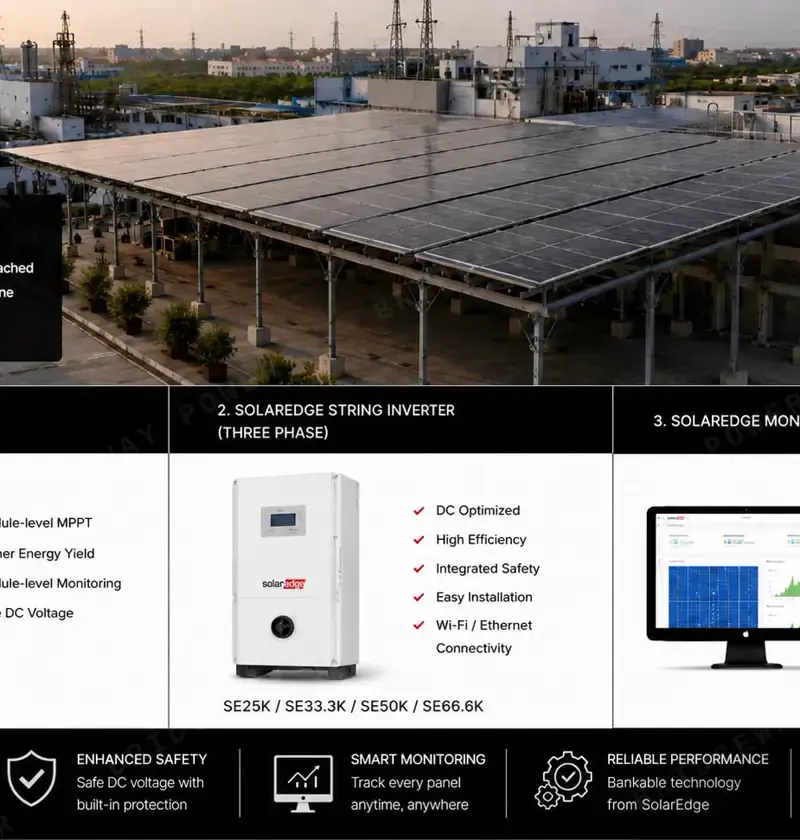
At Bridgeway Power, with 35+ years of experience, we help C&I clients navigate both the technical and regulatory aspects of solar. Whether you are looking for a 150 kWp SolarEdge Rooftop or exploring inter-state Open Access, our team ensures you maximize every available government incentive.
Ready to shield your business from rising tariffs? Book a free consultation with Bridgeway Power today.
Frequently Asked Questions
What happens to my ISTS waiver after 25 years?
After the 25-year period from the date of commissioning, the project will be required to pay the prevailing ISTS charges as determined by the CERC (Central Electricity Regulatory Commission).
Does the ISTS waiver apply to short-term power purchases?
Generally, the 100% or tiered waivers are applicable to Long-term and Medium-term Open Access. Short-term (day-ahead) trades often attract different transmission pricing structures.
If I commission my project in May 2026, what waiver do I get?
According to the current Ministry of Power guidelines, a project commissioned in May 2026 falls within the 1st July 2025 – 30th June 2026 window and would receive a 75% waiver.
Is the waiver applicable to Solar-Wind Hybrid projects?
Yes, ISTS waivers apply to hybrid projects as well. In fact, hybrid projects are often favored for ISTS because they utilize the transmission line more efficiently by generating power throughout more hours of the day.
Do I need to apply for the waiver separately?
No, the waiver is applied automatically by the National Load Despatch Centre (NLDC) and Regional Load Despatch Centres (RLDCs) when billing for transmission charges, provided your project meets the commissioning date criteria.
Can a residential society use the ISTS waiver?
While technically possible via Group Net Metering, ISTS is typically used by heavy industrial consumers. Residential societies in places like Dwarka are better served by Virtual Net Metering or rooftop solar.
Every 1 kW of solar on your roof offsets 1.5 tonnes of CO₂ per year
That's 40 trees planted — every year, for 25 years.
A typical 5 kW home system offsets 187 tonnes of carbon over its lifetime. That's equivalent to taking 8 cars off the road.
See your impact →How much can you save with solar?
Enter your electricity bill → get system size, subsidy amount & payback period
Get StartedGo solar without owning a rooftop
Community Solar gives commercial & institutional consumers the same savings — zero capex, zero roof needed.
Or get a free solar quote
Tell us about your rooftop — we'll call with exact savings for your home.
Related Articles
What Is Captive Open Access Solar (100% Equity Model)
Learn how Captive Open Access Solar (100% Equity Model) helps Indian businesses cut electricity costs by 40% using off-site solar plants. Guide on rules, savings & ROI.
Read moreHow Rooftop Solar Can Eliminate Your Electricity Bill
Discover how Net Metering and PM Surya Ghar subsidies can reduce your monthly electricity bill to near-zero. Learn about system sizing, costs, and real-world savings.
Read moreSolar Subsidy in Uttar Pradesh 2026: ₹1,08,000 for Noida, Ghaziabad & Greater Noida
UP's stacked solar subsidy 2026: ₹78,000 central + ₹30,000 UPNEDA state top-up = ₹1.08L. Real PVVNL net-cost math for Noida, Greater Noida, Ghaziabad & Meerut.
Read moreRelated guides
Delhi Electricity Rate 2026
BSES & Tata Power per-unit rates, PPAC, subsidy — sourced from DERC.
ExploreDelhi Solar Policy 2026
Free rooftop solar up to 3 kW for homes under 400 units. Eligibility & apply.
ExploreSolar Panel Price in Delhi
Live 2026 rooftop prices in Delhi after ₹1.56L subsidy. 1,200+ installs.
ExploreSolar Company in Gurgaon
Gurgaon's rooftop solar installer — 800+ systems, ₹78K PM Surya Ghar subsidy.
ExploreSolar Company in Noida
Noida & Greater Noida rooftop solar — 500+ installs, ₹1.08L stacked subsidy.
ExploreSolar Panel Price in Faridabad
Live 2026 Faridabad prices after ₹78K PM Surya Ghar subsidy. 350+ homes.
Explore