
By Arshi Chadha, Founder · Bridgeway Power
EV Charging at Home: What It Really Does to Your Electricity Bill (and How Solar Fixes It)
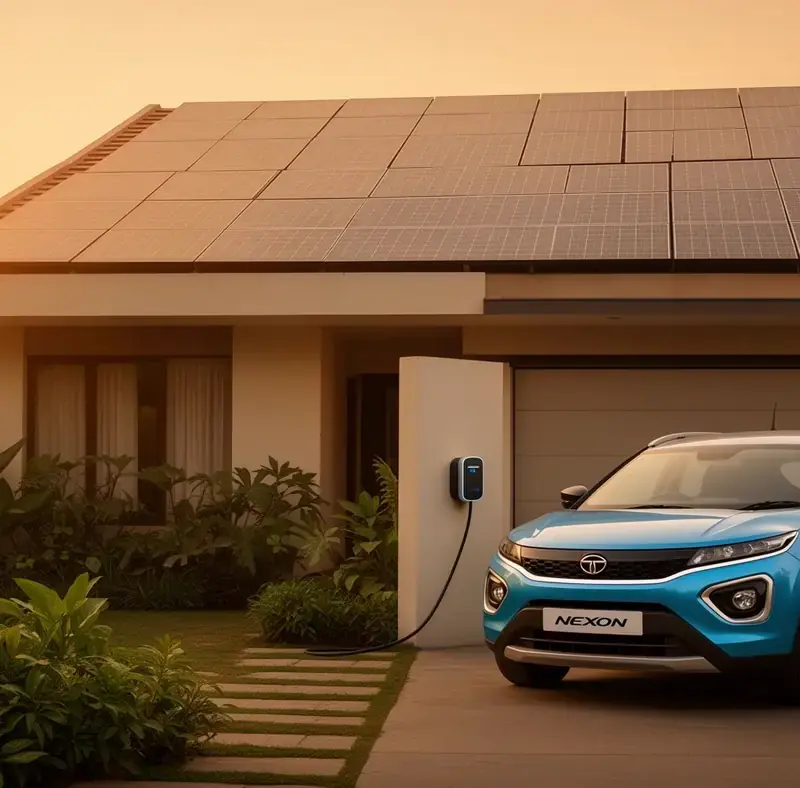
You're checking the rate — now see how much of your bill solar erases
Charging an EV at home in Delhi NCR typically adds 250–450 units per month to your electricity bill — about ₹2,500–₹6,500 extra, because EV charging pushes you into the highest BSES or Tata Power Delhi tariff slab. A 3 kW rooftop solar system offsets this entirely and cuts your EV running cost from ₹1.80/km to under ₹0.40/km, with a payback period of 3.5 years instead of 6.
The math nobody shows you before you buy an EV
Most EV buyers in India look at the per-km cost in marketing brochures — usually quoted as ₹1.20–₹1.50 per kilometre. What those brochures never mention is the slab inflation effect on your home electricity bill.
Here is how it actually works:
- A Tata Nexon EV consumes roughly 0.15 kWh per kilometre (15 kWh per 100 km)
- An average Delhi commute is 40 km/day, which is 6 kWh/day or 180 units per month just for driving
- Add another 70–100 units if you use AC charging losses and occasional weekend trips
- Total EV-only consumption: ~250 units/month
Your house was probably consuming 300–350 units/month before the EV. Add 250 EV units and you are suddenly at 550–600 units — squarely in the highest tariff slab where every additional unit costs ₹8.00 to ₹10.50 instead of the ₹3.00 you paid for your first 200 units.
A real Delhi household example
We ran the numbers for an actual Bridgeway Power customer in Pitampura, BSES Rajdhani area, who bought an MG Windsor EV in late 2025:
| Before EV | After EV (no solar) | After EV + 3 kW solar | |
|---|---|---|---|
| Monthly units | 300 | 650 | 80 (net) |
| Monthly bill | ₹2,400 | ₹6,800 | ₹640 |
| Per-km running cost | n/a (petrol) | ₹1.80/km | ₹0.36/km |
The EV-only step tripled the bill because of slab inflation, not because the EV itself is inefficient. The solar offset brings everything back to baseline and then some.
DISCOM tariff slabs — why EVs hurt so much
Both BSES Rajdhani Power Limited and BSES Yamuna Power Limited in Delhi, along with Tata Power Delhi Distribution (TPDDL), use a steeply tiered domestic tariff:
| Monthly units | BSES tariff (₹/unit) | Tata Power Delhi (₹/unit) |
|---|---|---|
| 0–200 | 3.00 | 3.00 |
| 201–400 | 4.50 | 4.50 |
| 401–800 | 6.50 | 6.50 |
| 801–1200 | 7.00 | 7.00 |
| Above 1200 | 8.00 | 8.00 |
Plus fixed charges, surcharges, and electricity duty that add roughly 30–35% on top of the slab rate. The effective rate for that 401st unit upward in a typical EV-owning household is ₹8.50–₹10.50/unit.
This is why the cost-per-km math feels so wrong when you look at your bill. You are not paying ₹1.20/km — you are paying the marginal slab rate, not the average rate the brochure used.
How solar fixes the slab problem
Net metering is the unlock. Here is the mechanic:
- Your solar panels produce power during daytime — exactly when your home load is lowest
- Excess units are exported to the grid and credited at your highest slab rate
- At night, when you charge your EV, you import units and they cancel against your daytime credits one-for-one
You are essentially using the grid as a free battery. The Bureau of Energy Efficiency (BEE) and MNRE PM Surya Ghar scheme both explicitly support net metering for residential rooftop installations up to 10 kW.
For most Delhi NCR EV-owning households, a 3 kW system is the sweet spot:
- Generates ~360 units/month on average
- Covers EV charging (~250 units) + base load (~300 units)
- After MNRE PM Surya Ghar subsidy of ₹78,000 (for 3 kW), net cost is ~₹1.2 lakh
- Payback drops from 6 years to 3.5 years because you are now offsetting expensive top-slab units, not cheap base-slab units
5-year cost comparison: petrol vs EV vs EV + solar
For a household driving 1,200 km/month (40 km/day):
| Year | Petrol car @ ₹6/km | EV @ ₹1.80/km (no solar) | EV @ ₹0.36/km (with solar) |
|---|---|---|---|
| 1 | ₹86,400 | ₹25,920 | ₹5,184 + ₹1.2L (system) |
| 2 | ₹86,400 | ₹25,920 | ₹5,184 |
| 3 | ₹86,400 | ₹25,920 | ₹5,184 |
| 4 | ₹86,400 | ₹25,920 | ₹5,184 |
| 5 | ₹86,400 | ₹25,920 | ₹5,184 |
| Total | ₹4.32 L | ₹1.30 L | ₹1.45 L |
By year 5, EV-with-solar matches EV-without-solar and your panels are still producing for another 20 years at near-zero marginal cost. By year 10, you are ₹2 lakh ahead of the no-solar EV path.
Talk to a solar engineer — not a salesperson
Check whether we install in your area, then get your answer on WhatsApp. No forms, no call centre.
See how much of this bill solar erases
Sizing solar for your specific EV
Different EVs have different consumption profiles. Here is the rough math we use for calculating exact solar payback for EV-owning households:
| EV Model | Battery | kWh/100 km | Monthly EV units (40 km/day) | Recommended add-on |
|---|---|---|---|---|
| Tata Tiago EV | 24 kWh | ~10 | 120 | +1 kW (2 kW total) |
| Mahindra XUV400 | 39 kWh | ~14 | 168 | +2 kW (3 kW total) |
| Tata Nexon EV | 40 kWh | ~15 | 180 | +2 kW (3 kW total) |
| MG Windsor EV | 38 kWh | ~14 | 170 | +2 kW (3 kW total) |
| Mahindra BE 6 | 59 kWh | ~17 | 200 | +3 kW (4 kW total) |
The "add-on" assumes you already have a base-load system covering ~300 units/month. If you are starting from zero solar, just add the recommended add-on to your base sizing.
How to size solar for your EV in 4 steps
- Measure your current consumption. Pull your last 12 months of electricity bills and calculate the average monthly units. This is your base load.
- Calculate your EV's monthly consumption. Multiply your daily km by 0.15 (or use the table above for your specific model). Multiply by 30 for monthly units.
- Add the two together. This is your target monthly generation. Divide by 120 (Delhi's average monthly units per kW) to get your system size in kW.
- Round up by 0.5–1 kW to account for cloudy days, panel degradation, and future EV upgrades. Apply for the MNRE PM Surya Ghar subsidy if your system is 3 kW or below for maximum benefit.
The night-charging objection (and why it does not matter)
The most common objection we hear: "But I charge my EV at night when there is no sun!"
This is a misunderstanding of how net metering works in Delhi. You are not running your EV directly off your panels — you are banking units during the day. The grid acts as your battery. At month-end, your bill nets out.
The only case where this breaks down is if your monthly EV consumption exceeds your solar generation. That is why we size systems to cover EV + base load with ~10% headroom, not just EV consumption.
If you experience frequent power cuts and want true backup capability for your EV, look at hybrid solar with battery for EV night charging — but for most Delhi NCR homes on stable grids, plain net-metered solar is the more economical choice.
Government schemes that help EV + solar buyers
Three policies stack favorably right now:
- MNRE PM Surya Ghar Yojana: Up to ₹78,000 subsidy for residential rooftop solar up to 3 kW. Approved through your DISCOM (BSES or TPDDL) — see our complete Delhi rooftop solar subsidy guide.
- FAME-II / PM E-Drive: Direct subsidy on EV purchase, varies by state and vehicle category.
- Delhi state EV policy: Additional incentive for EVs registered in Delhi, plus road tax waiver.
There is currently no integrated "EV + solar" subsidy in India — you apply for each separately. But the math works in your favor anyway.
FAQ
How much does it cost to charge an EV at home in India?
At Delhi DISCOM tariffs, charging an EV that consumes 0.15 kWh/km will cost roughly ₹1.50–₹2.00 per km for a household already in the upper tariff slabs. With rooftop solar offsetting consumption, this drops to ₹0.30–₹0.40 per km — an 80% reduction.
Will my electricity bill really triple when I buy an EV?
For a typical Delhi NCR household consuming 300 units/month before the EV, adding 250 EV units pushes you into the highest tariff slab. Bills commonly go from ₹2,400 to ₹6,800/month — a 2.8x increase, not because the EV is inefficient but because of slab inflation.
Is solar worth it for EV owners in India?
Yes, more than for non-EV households. Because EV charging pushes consumption into the highest tariff slabs (₹8–10.50/unit), every kWh your solar offsets saves you the marginal rate, not the average rate. Payback periods drop from ~6 years to ~3.5 years specifically for EV households.
What size solar system do I need for a Tata Nexon EV?
For a household driving the Nexon EV ~40 km/day, you need roughly 2 kW dedicated to the EV plus your base-load sizing — typically a 3 kW total system for most Delhi NCR homes. This generates ~360 units/month, enough to cover both EV charging and average household use.
Can I use net metering for EV charging?
Yes. Net metering treats all units the same — daytime solar exports cancel against night-time imports for your EV. Both BSES and Tata Power Delhi offer net metering for residential rooftop systems up to 10 kW under the MNRE PM Surya Ghar scheme.
How long is the payback if I install solar specifically for my EV?
For Delhi NCR EV-owning households, payback is 3 to 4 years instead of 5–6 years for a non-EV household. The reason: solar offsets your most expensive marginal-slab units, not your cheap base-slab units.
Ready to run your numbers?
Every household is different. The fastest way to know whether the math works for your specific bill, EV model, and roof is to use our rooftop solar for Delhi NCR homes calculator with your actual electricity bill — it factors in DISCOM slabs, your EV's consumption, and the current PM Surya Ghar subsidy automatically.
Or just send us a photo of your last electricity bill on WhatsApp and we will tell you exactly what size system pays back fastest for your situation.
Every 1 kW of solar on your roof offsets 1.5 tonnes of CO₂ per year
That's 40 trees planted — every year, for 25 years.
A typical 5 kW home system offsets 187 tonnes of carbon over its lifetime. That's equivalent to taking 8 cars off the road.
See your impact →How much can you save with solar?
Enter your electricity bill → get system size, subsidy amount & payback period
Get StartedLiked this article? Get a free solar quote
Tell us about your rooftop — we'll call with exact savings for your home.
Related Articles
Net Metering in India: How to Sell Solar Power Back to the Grid
Learn how net metering in India allows you to sell solar power back to the grid. Discover state policies, savings examples, and how to reduce your bill by 90%.
Read moreWhat Is Captive Open Access Solar (100% Equity Model)
Learn how Captive Open Access Solar (100% Equity Model) helps Indian businesses cut electricity costs by 40% using off-site solar plants. Guide on rules, savings & ROI.
Read moreSolar Installation Cost in Delhi NCR 2026: 3 kW at ₹1.32L net
Updated 2026 guide to solar costs in Delhi NCR. Learn about PM Surya Ghar subsidies, system pricing from 1kW-10kW, and how to reach zero electricity bills.
Read moreRelated guides
Delhi Electricity Rate 2026
BSES & Tata Power per-unit rates, PPAC, subsidy — sourced from DERC.
ExploreDelhi Solar Policy 2026
Free rooftop solar up to 3 kW for homes under 400 units. Eligibility & apply.
ExploreSolar Panel Price in Delhi
Live 2026 rooftop prices in Delhi after ₹1.56L subsidy. 1,200+ installs.
ExploreSolar Company in Gurgaon
Gurgaon's rooftop solar installer — 800+ systems, ₹78K PM Surya Ghar subsidy.
ExploreSolar Company in Noida
Noida & Greater Noida rooftop solar — 500+ installs, ₹1.08L stacked subsidy.
ExploreSolar Panel Price in Faridabad
Live 2026 Faridabad prices after ₹78K PM Surya Ghar subsidy. 350+ homes.
Explore