
By Vansh Dahiya · Reviewed by Arshi Chadha, Founder
Solar Net Meter Not Working? Negative Readings and DISCOM Replacement
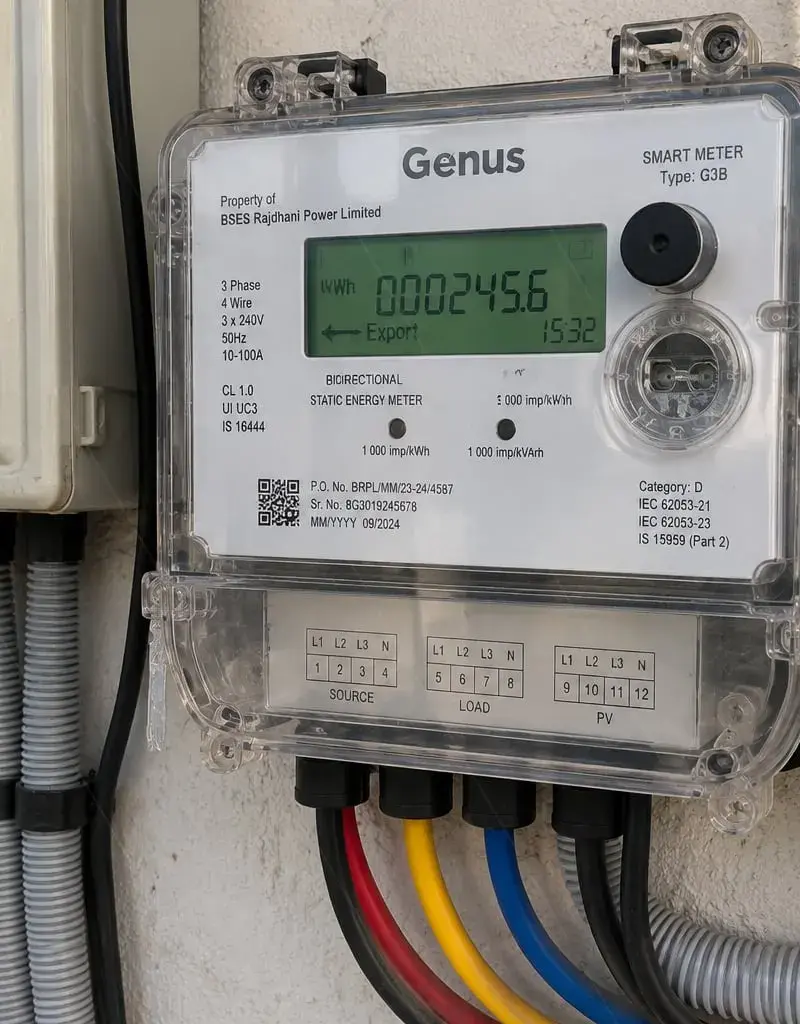
Net meter reading wrong? Get it proven.
We test the plant, produce the evidence your DISCOM needs, and file the meter replacement complaint with you.
Quick answer
A solar net meter showing a negative reading, a frozen display or zero export is a metering fault, not free electricity. Import and export sit in separate registers; export credited into the import register means a reversed connection. The net meter is DISCOM property, so replacement is their responsibility. File a written net-metering complaint against your consumer account number with three days of meter photographs and matching inverter generation data.
| Inverter generation | Net meter export | Likely cause | Who fixes it |
|---|---|---|---|
| Normal | Zero / not moving | Meter or connection fault | DISCOM |
| Normal | Import rising, export flat | Reversed connection | DISCOM |
| Zero or low | Zero | Plant fault | Your EPC |
- •Import and export sit in separate registers. Export credited into the import register means a reversed CT or wrong connection.
- •A reading that jumps backwards is usually a register rollover or meter reset, not lost energy.
- •Export showing zero while your inverter is generating is a meter or connection fault, not a panel fault.
- •The net meter belongs to the DISCOM. You raise the complaint; they test and replace.
- •Do not break the DISCOM seal or let anyone open the meter — that shifts liability to you.
Short answer: A solar net meter that shows a negative reading, a frozen display or a sudden jump is almost never "free electricity" — it is a metering fault, a reversed connection, or a register rollover. Your DISCOM owns the net meter, so replacement is their job, but they act on a written complaint with evidence. Photograph the meter display, keep your last three bills, and file the complaint against your CA number before the next billing cycle closes.
First, tell a meter fault apart from a plant fault
Before blaming the meter, check whether your system is generating at all. Read the inverter's daily generation figure and compare it against the Delhi NCR band of 3.5–4.5 units per kW per day on a clear day.
| Inverter generation | Net meter export | Likely cause |
|---|---|---|
| Normal | Zero or not increasing | Meter or connection fault — raise with DISCOM |
| Normal | Import register rising with export flat | Reversed connection / sign convention error |
| Zero or low | Zero | Plant fault — inverter, string or isolator, not the meter |
| Normal | Sudden drop to near zero | Meter reset, replacement, or register rollover |
| Normal | Export looks impossibly high | Multiplication factor or CT ratio set wrong at installation |
That table decides who you call. A plant fault is an EPC job; a metering fault is a DISCOM job.
What a "negative reading" usually is
Energy meters count upward on fixed-digit registers. Three things produce an apparently negative or backwards reading:
- Rollover. The register hits its maximum and wraps to zero. The difference across the wrap reads negative but no energy was lost.
- Meter reset or replacement. A new or re-programmed meter starts near zero. Your billing has to be segmented at that date.
- Reversed polarity or swapped CT. Generation lands in the import register instead of export. This one costs you real money every month it runs, because you are billed for units you exported.
The third is the one to act on urgently. The tell is that import rises faster than your actual consumption while export stays near zero, and the two roughly mirror each other in magnitude.

The DISCOM replacement procedure, step by step
- Collect evidence. Photograph the meter display showing both import and export registers, with the date visible. Do it on three consecutive days so a stuck register is provable.
- Pull your inverter data. Daily generation for the same three days. This is what proves the plant is working and the meter is not.
- Keep the last three bills. Billing history shows when the pattern broke.
- File a written complaint against your consumer account (CA) number, specifically under net metering — not a generic "high bill" complaint, which routes to a different desk.
- BRPL / BYPL: BSES consumer portal or division office, quoting the CA number and net-metering agreement reference.
- TPDDL: net-metering section of the consumer portal.
- DHBVN (Gurugram, Faridabad): SDO office of your sub-division, in writing.
- NPCL / PVVNL (Greater Noida, Ghaziabad): consumer care with the CA number and connection reference.
- Ask for a meter testing report. The DISCOM tests the meter on the bench. If it fails, they replace it free and you can request a billing correction for the affected period.
- Get the final reading recorded. When the meter is swapped, insist the old meter's import and export readings are written on the replacement report. Without that, the corrected bill cannot be computed.
Never break the seal, never let a third-party electrician open the meter, and never accept a meter change without a signed replacement report.
Talk to a solar engineer — not a salesperson
Check whether we install in your area, then get your answer on WhatsApp. No forms, no call centre.
What would solar save on YOUR bill?
Getting the wrong bills corrected
A billing correction is a separate request from the meter replacement, and it needs the meter testing report as its basis. Ask for a revision for every cycle from the date the fault is provable in your evidence — not from the date you complained. This is exactly why the three-day photo record matters.
When to call us instead
If you are not sure whether the fault is on your side of the meter or the DISCOM's, that diagnosis takes a clamp meter and half an hour. We run it as part of a rescue audit, produce the evidence pack the DISCOM needs, and file the complaint with you. We maintain 10 MW+ across 1,300+ rooftops in Delhi NCR, including systems other companies installed.
FAQ
My solar net meter is showing a negative reading. Is that bad?
Usually it means a register rollover, a meter reset, or a reversed connection. Only the reversed connection costs you money — it bills you for the units you exported. Compare import and export movement over three days to tell them apart.
The net meter is not recording my solar export at all. What do I do?
Check your inverter is generating first. If it is, the fault is in the meter or its connection. File a written net-metering complaint with your DISCOM quoting your CA number and ask for a meter testing report.
Who pays for a faulty net meter replacement?
The net meter is DISCOM property. If the bench test shows the meter is faulty, replacement is at the DISCOM's cost. You pay only if the damage is attributable to the consumer's installation.
Can I get my inflated bills refunded after the meter is replaced?
Yes, through a billing revision request based on the meter testing report. Ask for the correction to run from the date your evidence shows the fault started, and keep the old meter's final readings on the replacement report.
How long does a DISCOM take to replace a net meter?
It varies by division and meter stock. Written escalation with the testing-report request moves it faster than repeated phone calls, because only the written trail creates a dated record.
Every 1 kW of solar on your roof offsets 1.5 tonnes of CO₂ per year
That's 40 trees planted — every year, for 25 years.
A typical 5 kW home system offsets 187 tonnes of carbon over its lifetime. That's equivalent to taking 8 cars off the road.
See your impact →How much can you save with solar?
Enter your electricity bill → get system size, subsidy amount & payback period
Get StartedLiked this article? Get a free solar quote
Tell us about your rooftop — we'll call with exact savings for your home.
Related Articles
Solar Installer Disappeared? How to Rescue an Orphaned Rooftop System
Your installer folded. The system is still yours, and so are the manufacturer warranties. Here is how an orphaned rooftop plant gets audited, repaired and taken over.
Read moreAnnual Solar Maintenance Cost in India: DIY vs AMC vs One-Time Service
Learn the real annual solar maintenance cost in India for 2026. Compare DIY, one-time service, and AMC plans to maximize your rooftop solar savings.
Read moreHow to Correctly Read Your Solar Net Meter Display
Master how to read solar net meter displays (Secure/Genus), understand Export vs. Import codes, and verify your DISCOM bill accuracy in Delhi NCR.
Read moreRelated guides
Orphaned Solar Rescue
Installer gone, inverter down, subsidy stuck? We audit, repair and take over.
ExploreSolar Service Near Me
AMC, repair & cleaning across Delhi NCR — same-week response.
ExploreSolar AMC Plans
Annual maintenance contracts to keep your system at 95%+ uptime.
ExploreInstaller Disappeared?
Your warranties survive the installer. How an orphaned rooftop gets taken over.
ExploreSolar AMC in Faridabad
Quarterly cleaning, inverter diagnostics, generation monitoring — Faridabad HQ team.
ExploreSolar Inverter Repair
All brands. Same-day diagnostic. 90-day repair warranty.
Explore